According to Michelangelo the Highest Object of Art for Thinking Men Was
Michelangelo and the Sistine Chapel - the truthful story behind the Agony and the Ecstasy
Michelangelo and the Sistine Chapel.It's hard to recollect of ane without thinking of the other.
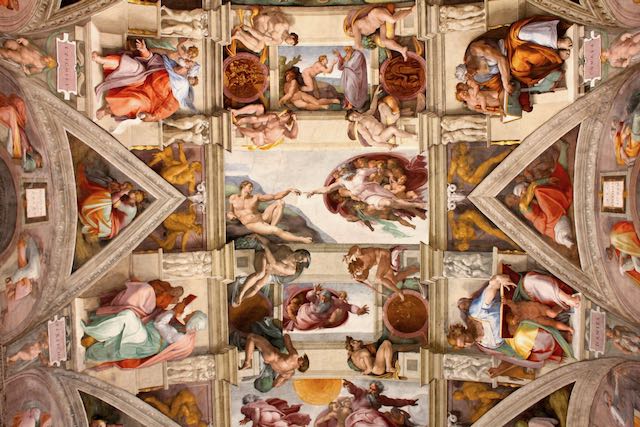 Sistine Chapel ceiling, Michelangelo Buonarroti 1508 - 1512.
Notice out how an unlikely, inexperienced sculptor got the job to pigment what would become one of the greatest masterpieces the world has always seen.
Michelangelo and the Sistine Chapel - a brief history
I was writing a page about the Sistine Chapel, and I realized I needed to dedicate a whole folio to Michelangelo and the Sistine Chapel.
Non to the lowest degree because Michelangelo is my favorite artist of all fourth dimension (I am biased, what can I say?)
Every bit you might imagine, many books have been written on the subject.
Fine art historians take spent their careers studying this one topic.
At that place's and so much I could tell you about Michelangelo and the Sistine Chapel, but I have created this page to give yous some of the basic information to get started.
On this page yous'll find out about:
- How, why, and when the Sistine Chapel was built
- Who was Michelangelo?
- Pope Julius 2 and Michelangelo - tough dearest
- Michelangelo and the Sistine Chapel - The ceiling paintings
- Michelangelo and the Sistine Chapel - The Last Judgement
- Sistine Chapel virtual tour
To find out more about the best way to visit the Sistine Chapel, visit my page here.
A different kind of page on Romewise
This folio about Michelangelo and the Sistine Chapel is a fleck different from nearly pages you lot volition find on this site.
I wanted to requite you some of the history, but at that place is so much to tell, I had to be selective!
Yous can find a bibliography at the bottom.
This page is for those of you who want a fleck of detail virtually the history, compages, and paintings of the Sistine Chapel, in particular Michelangelo's piece of work there.
I hope you lot find this page about Michelangelo and the Sistine Chapel interesting!
How, when, and why the Sistine Chapel was built
The story of Michelangelo and the Sistine Chapel begins before Michelangelo was born, withPope Nicholas V and Pope Sixtus IV' s changes to the Vatican.
Pope Nicholas 5 and Fra Angelico
In the mid-1400s,Pope Nicholas Five decided to make some major changes to the Vatican.
Too as having plans made for the "Sometime Saint Peter's basilica" to be rebuilt,he also decided that the Vatican was where the Pope should live and had a chapel made for his individual use in the Vatican Palace.
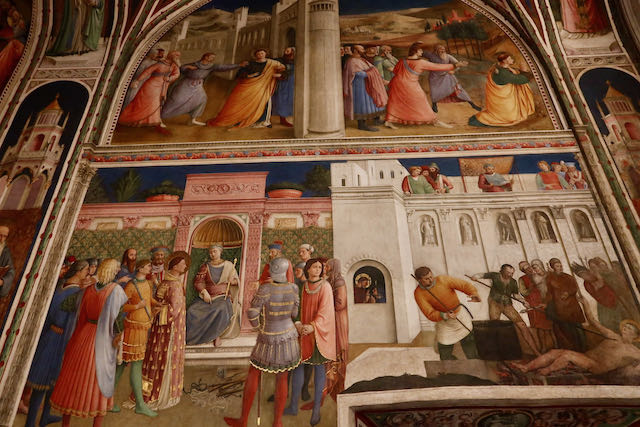 Niccoline Chapel and frescoes by Fra Angelico, a precursor to Michelangelo and the Sistine Chapel.
Pope Nicholas V had one of the best artists of the day, Fra Angelico , cover the inside of this chapel with frescoes which still exist today.
While this became the Pope'south private chapel, there was another papal chapel on Vatican grounds. It was known equally the " Cappella Magna, " which means greater chapel.
How to run into the Niccoline Chapel inside the Vatican
Yous can visit the Niccoline Chapel if you take a tour of the Vatican Secret Rooms.
Pope Sixtus IV and his chapel
When the Sistine Chapel was inaugurated in 1483, Michelangelo Buonarroti was only viii years sometime.
Francesco della Rovere was elected pope in 1471. He took the proper noun Sixtus IV.
Pope Sixtus IV was known for many things including rebuilding the Cappella Magna , which had become bedraggled.
Between 1473 and 1481, architects worked to rebuild the chapel before information technology was opened in 1483.
It was thereafter chosen the Sistine Chapel, named for Pope Sixtus Iv .
Sistine Chapel compages
The outside is plain, typical of churches of the time. In that location's no decorative doorway, since access to it is from inside the Papal Palace.
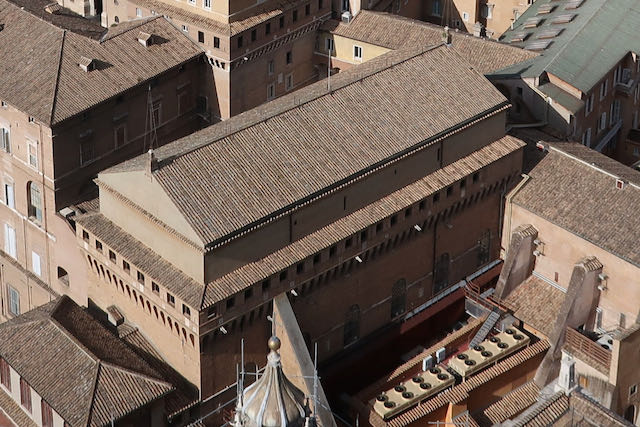 The exterior of the Sistine Chapel is austere and fortress-like, every bit information technology was intended when information technology was built in the 15th century.
The architecture of the Sistine Chapel follows the dimensions of Solomon'due south Temple from the Sometime Testament , or 6:ii:3.
The primary chapel space is 134 anxiety long by 44 feet wide, with a ceiling height of 68 feet.
The ceiling is a barrel vault with windows. It was meant to besides human activity as a fortress, another architectural feature that was typical of churches of the period.
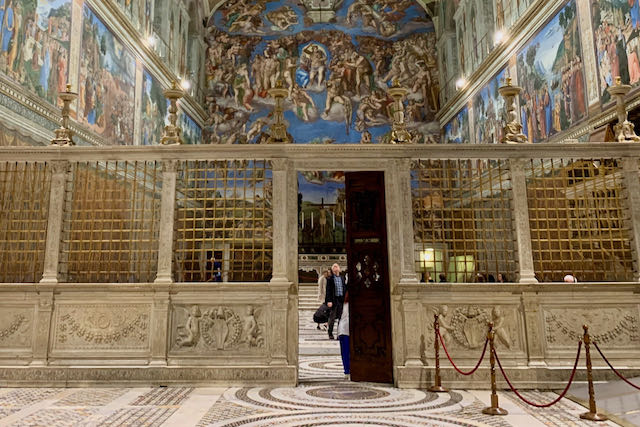 It's easy not to notice this marble screen that stretches across the Sistine Chapel just it's absolutely beautiful and actually worth looking at.
There is a marble screen ( transenna ) across the middle of the chapel.
Information technology was meant to split up the Pope from the faithful who would stand in the back of the chapel.
Originally it divided the Sistine Chapel exactly in half only over time, as the Pope required more than attendants, the screen was moved back to where it stands today.
Who was Michelangelo?
Earlier we get into Michelangelo and the Sistine Chapel, hither'due south a lilliputian scrap virtually his early life.
Michelangelo Buonarroti was born March 6, 1475, near Arezzo, about 40 miles outside of Florence.
When he was 13, Michelangelo apprenticed in the workshop of the foremost Florentine creative person of the solar day, Domenico Ghirlandaio. Even at that historic period, Michelangelo's raw talent shone through.
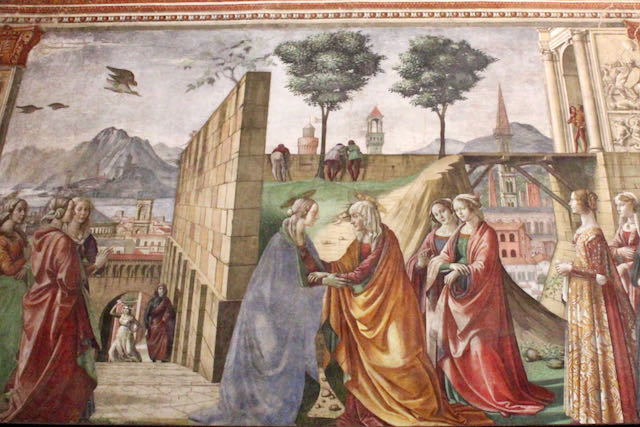 In this painting on the altar of Santa Maria Novella in Florence, Domenico Ghirlandaio immune Michelangelo to paint the three figures in the background, with their backs to us.
Lorenzo de Medici, was a great lover of the arts. He had the best creators live on his property as a sort of artists' colony, giving them room and lath, materials, and the time and space to create.
Michelangelo spent some of his formative years here. This is where his honey for sculpting and his innate talent began to really polish through.
He became so passionate about wanting to sculpt the human body correctly that he paid an attendant at the city morgue to sneak in at night and cut open the bodies of unclaimed corpses. This was illegal and punishable by death, but Michelangelo was adamant.
Without having seen the Sistine Chapel, one tin course no observable idea of what one man is capable of achieving.— Johann Wolfgang Goethe, 23 August 1787
Michelangelo began getting larger and larger commissions, earlier he got a commission to come up to Rome and sculpt something for a side chapel in Old Saint Peter's Basilica when in his early twenties.
Past the time Michelangelo finished his masterpiece, the Pietà, his patron had died. Not only that, but the basilica where information technology was to go was leaning heavily, and Michelangelo was afraid to put his piece of work in in that location for fear information technology would be crushed when the building collapsed. Nonetheless, he and some friends snuck it in, wherePope Julius II would come across it.
Disclosure : If you make a purchase through a link on this page, I may receive a small committee - at no extra cost to yous. Thanks for supporting my site!
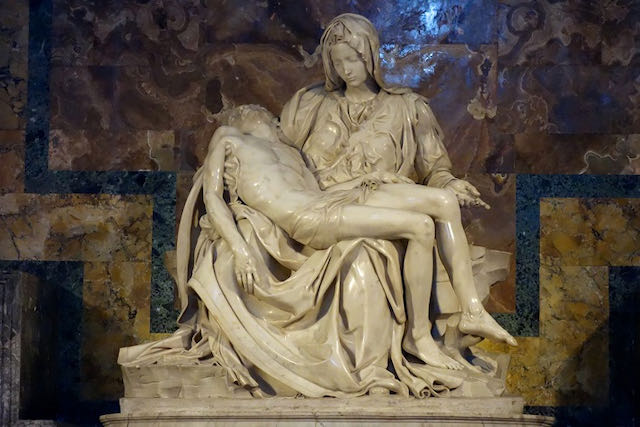 Michelangelo and the Sistine Chapel - there is more than of his piece of work around the Vatican and Rome, similar his stunning Pietà in Saint Peter's Basilica.
Pope Julius 2 and Michelangelo - tough love
Pope Julius II was the nephew of Pope Sixtus IV, and was a human to be reckoned with.
He was nicknamed "the warrior pope" considering he actually went to battle defending Rome and the papacy.
Pope Julius Two decided Michelangelo should build his tomb.
And it was to be monumental, literally.
Information technology was going to be so grandiose that both the Pope and Michelangelo agreed that Saint Peter's Basilica needed to be rebuilt to house it.
how Pope Julius Ii harangued a sculptor and convinced him to paint
Pope Julius Ii had a lot of projects at the Vatican.
He was collecting antiquities that were being unearthed around Rome. These included the Laocoön sculpture, the Belvedere trunk, and the Belvedere Apollo. Michelangelo was heavily influenced by this aboriginal Greco– Roman art.
Pope Julius began the drove that would become the Vatican Museums besides as revisiting thethought of rebuilding Saint Peter's Basilica.
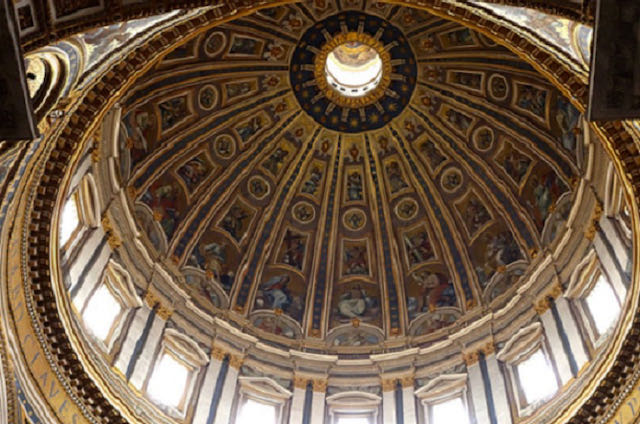 Michelangelo had a hand in much of what yous see today at the Vatican, including the blueprint of the dome.
The first main architect for the basilica that Pope Julius consulted wasDonato Bramante, who was non thrilled about a young upstart getting such a big commission from the Pope for the tomb project.
Bramante thought he might try to nip this in the bud by suggesting that the Pope have Michelangelo paint the ceiling of the Sistine Chapel, yet some other of the Pope's many projects.
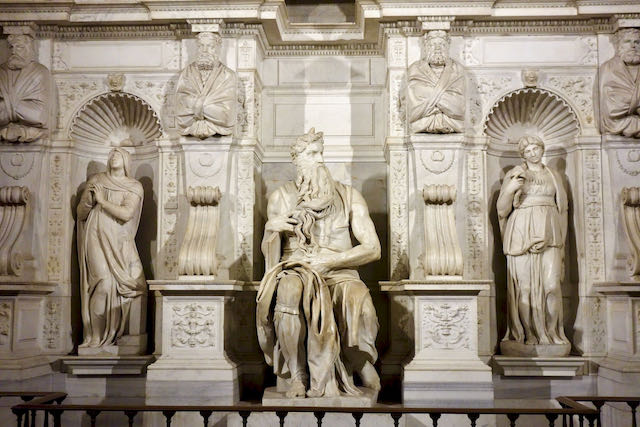 Michelangelo's Moses for the (unfinished) tomb of Pope Julius II is yet another of his masterpieces. You can it see in the church of San Pietro in Vincoli near the Colosseum in Rome.
At showtime, Michelangelo refused on the basis thathe was a sculptor and wanted merely to sculpt, not paint.
He was too in the middle of sculpting the pope's tomb, and he didn't like to interrupt his work, in one case begun. There was quite a bit of back and forth only in the end, y'all know who won that argument.
The Pope wanted Michelangelo to pigment the 12 apostles.
Michelangelo said, let'south call back large, actually large. Allow's recall Genesis! The start book of the Bible.
And you know who won that argument too.
Painting the ceiling of the Sistine Chapel
how the project began
Michelangelo had honed his cartoon skills in Ghirlandaio's workshop.He had as well learned a fiddling bit about fresco painting by assisting more experienced fresco artists.
But he still saw himself primarily as a sculptor, and that is the work he loved nearly. He never wanted to paint.
And so, when Michelangelo finally accepted the chore to paint the Sistine Chapel ceiling, he brought a few trusted artists from his native Florence to work with him, partly to assistance him get started with this technique.
the scaffolding
Obviously, Michelangelo would demand some sort of scaffolding.
Bramante and his assistants built scaffolding to Michelangelo's specifications. It was a flat, wooden platform that came out from the side walls loftier upwardly near the tops of the windows.
Contrary to the romantic idea of Michelangelo lying on his back to paint the Sistine Chapel, Michelangelo actually stood on his scaffolding while he painted.
Think about doing this for four years. It caused Michelangelo tremendous cervix and back strain, and damaged his eyesight irrevocably.
Ceiling Elements
Michelangelo had a daunting job ahead of him. How to fill a 6,000 square feet expanse?
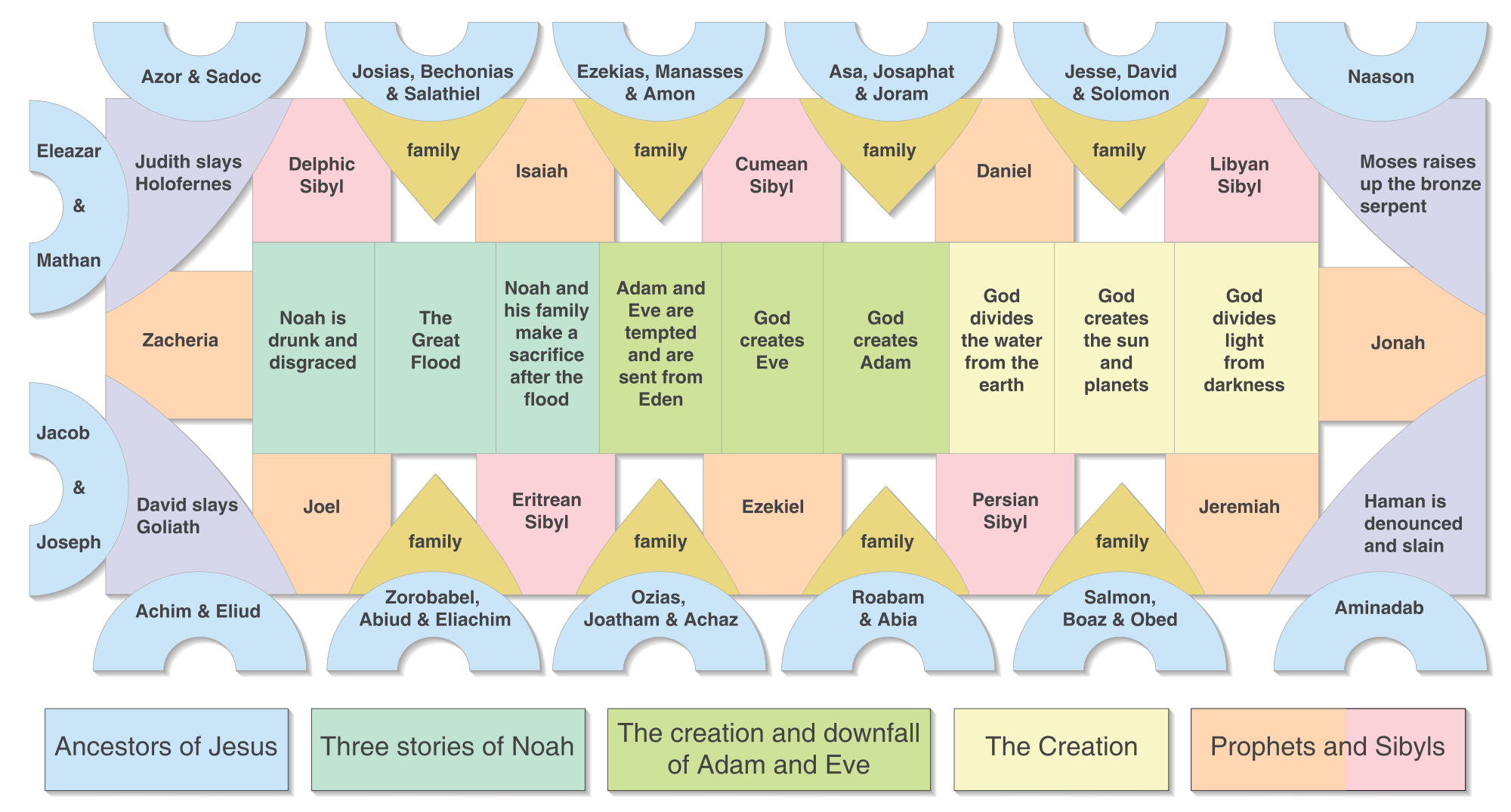 Diagram of the Sistine Chapel ceiling. TTaylor work adjusted by Begoon - on Wikimedia Eatables
Certainly the most admired section of the ceiling today is the vault in the center with its nine panels from the Quondam Testament.
The panels are divided into three sections, each with three paintings. They represent:
- The Cosmos of the Heavens and Earth
- The Cosmos of Adam and Eve (Humankind)
- Noah and the Corking Flood
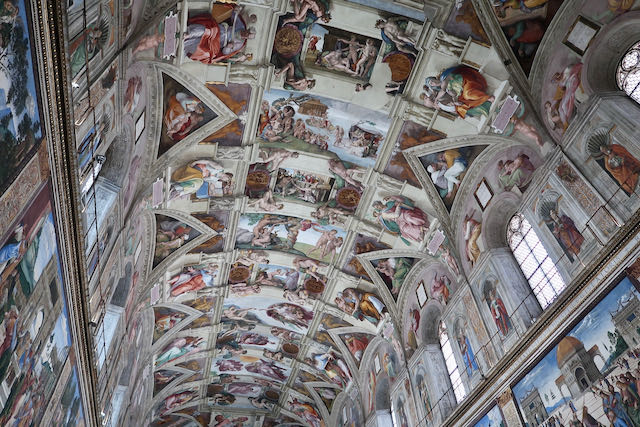 Michelangelo and the Sistine Chapel - the most famous part is the nine-panel department depicting Genesis in the center vault.
Noah and the flood
Michelangelo began by painting the stories of Noah and the Overflowing .
These panels were uttermost from the altar where the Pope would stand, and he wanted to starting time here so that he could improve his technique every bit he moved closer to the chantry, as well as giving him time to determine how to pigment God.
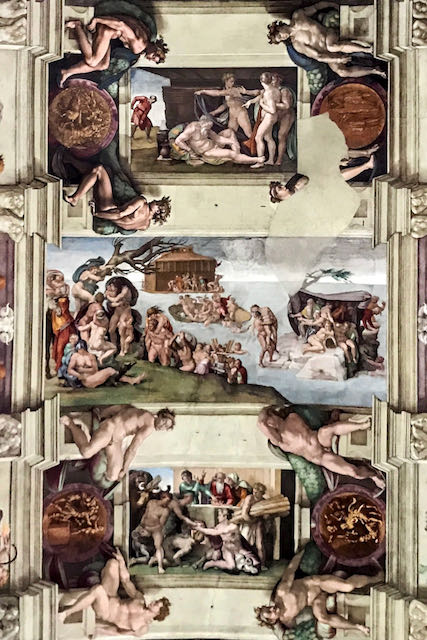 Michelangelo and the Sistine Chapel - the story of Noah and the Deluge.
If yous enter the Sistine Chapel from the back, the commencement panel is of the Drunkenness of Noah. This is followed by theGroovy Flood and thenthe Sacrifice of Noah.
These panels are really out of order, but it may be that Michelangelo needed the big center panel to draw more scenes of the flood. On that panel alone, he painted over 60 figures, depicting the tragedy most to befall them.


Adam and Eve
In 1510, Michelangelo took a yr off from painting the Sistine Chapel.The Pope was impatient and forced Michelangelo to unveil what he'd already done. The crowds were awed. Only Michelangelo had still to pigment what would become his masterpiece - God's creation of humankind.
When Michelangelo began to paint the scenes depicting Adam and Eve, he had a much improve handle on fresco work, and he understood the kind of image he needed to portray to make an affect on viewers beneath.
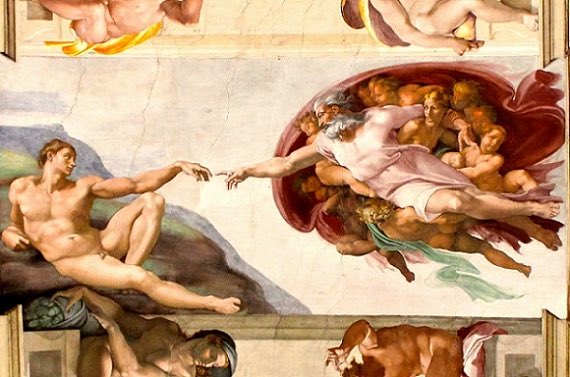 Michelangelo and the Sistine Chapel - Cosmos of Adam 1508–1512.
He had also had plenty of time to determine how he would portray God.
In these panels, God is portrayed as a grayness-bearded rugged old homo. Nobody had e'er depicted God this way before. But since and so, information technology has become normal to run into this in religious paintings. Michelangelo changed everything.
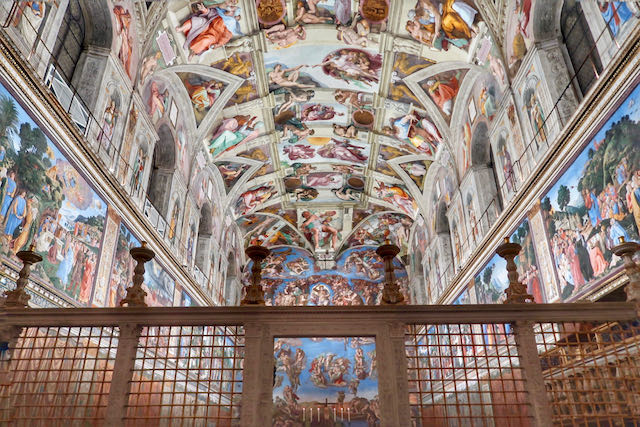 Michelangelo and the Sistine Chapel - his ceiling depicts scenes from Genesis, while his Last Sentence on the back wall is about the Apocalypse.
God creates the universe
The last three panels are from the starting time of Genesis, showing God creating the universe.
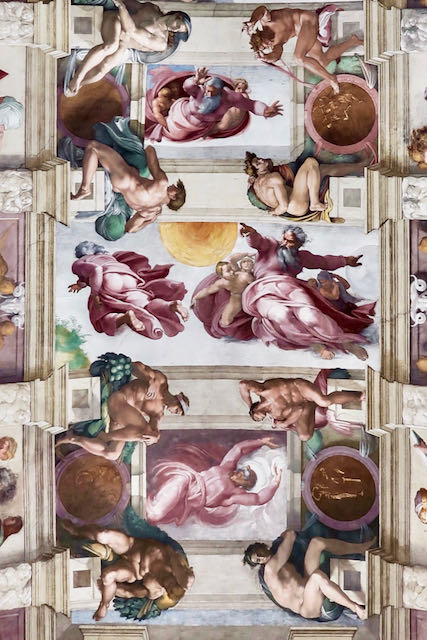 Michelangelo and the Sistine Chapel - These three panels are from Genesis and depict God creating the universe.
On the start panel, God creates light, separating it from darkness. The middle console shows God creating the lord's day, moon and plants and the third panel shows God dividing the waters from the heavens.
Michelangelo finished the Sistine Chapel ceiling in October 1512, wowing everyone when it was unveiled.
Michelangelo and the Sistine Chapel - The Terminal Judgement
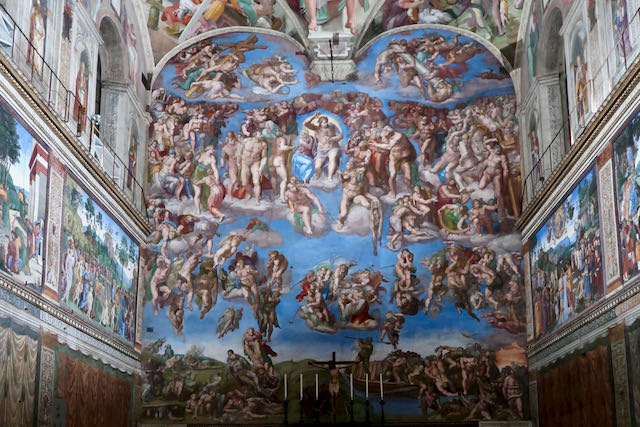 The Last Judgment. The genius of Michelangelo fatefully immortalizes the moment in which the angels announce the unleashing of the Apocalypse, with a smash of trumpets.
What happened next
In September 1534, just days earlier his death, Pope Cloudless VII commissioned Michelangelo to pigment the back wall behind the chantry of the Sistine Chapel.
Preparations for the wall began in 1535, and Michelangelo painted the wall under the jurisdiction of Pope Paul III (Farnese), between 1536 and 1541.
Times had changed. In the years following Michelangelo's completion of the ceiling frescoes, much had happened in Rome, Italy, and Europe and Michelangelo'due south outlook on life had grown darker. This was reflected in the painting he created, the Concluding Sentence .
the meaning of the Last JudgEment
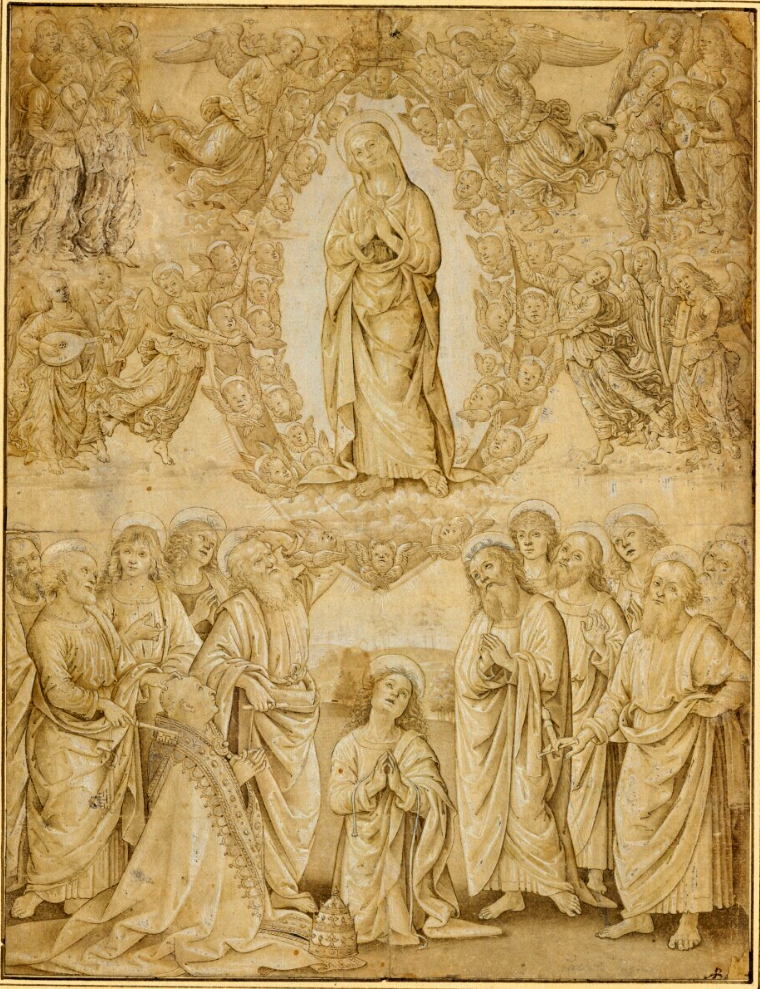 The original painting on the altar wall of the Sistine Chapel was the Assumption of the Virgin Mary past Perugino. Only this sketch survives.
The unabridged wall behind the altar of the Sistine Chapel is covered with Michelangelo'due south Last Judgment.
The Last Judgment shows the second coming of Christ and the final judgment of those doomed to hell or being sent to heaven.
The painting shows Christ in the centre, with his mother Mary adjacent to him,surrounded by the 12 apostles.
Altogether there are over 300 figures, with nearly all the males and angels originally shown every bit nudes.
The painting shows souls saved and rising toward sky on the left. On the right, yous can see souls that are damned and are existence pulled down towards hell.
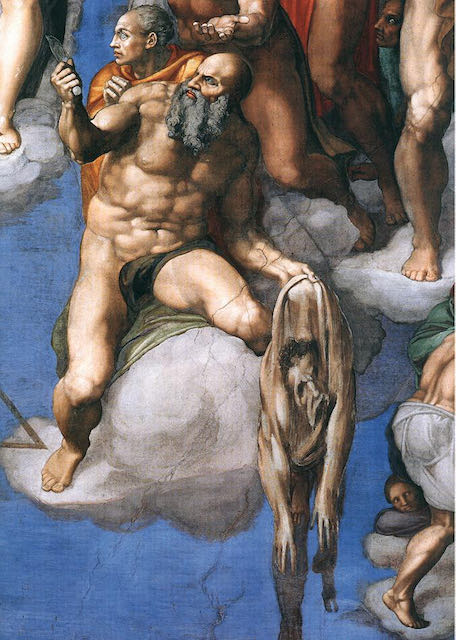 In the Last Judgment, San Bartolomeo has a place of honor and has ever been one of the most allegorical figures in the fresco. According to some scholars, the flayed peel he holds in his paw could very well be a self-portrait of Michelangelo
To the right of Christ, you lot can see St. Bartholomew with his flayed skin.
Most scholars agree that the face in the skin is that of Michelangelo, a cocky portrait.
Some speculate this was a reflection of Michelangelo'due south anguish at beingness forced to paint however again.
Other theories suggest Michelangelo was trying to redeem himself for things he had washed when he was younger. He had become more devout with age, and maybe he was worried about the fate of his soul.
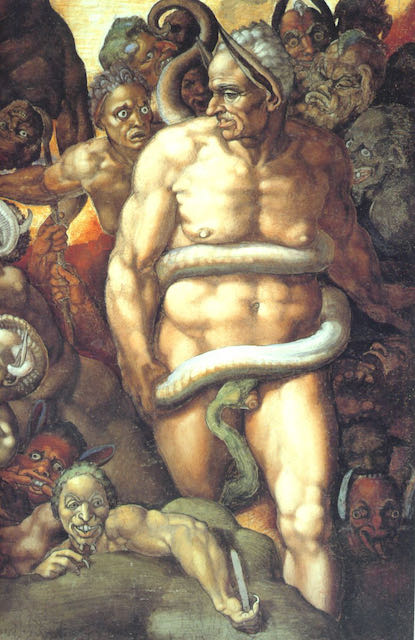 Minos. The feared judge of darkness. Another mythological figure painted by Michelangelo
Satan himself is not depicted, but at the bottom right we run across Minos, supervising the access of the damned into Hell.
When the Concluding Sentence was consummate, Pope Paul III supposedly savage to his knees before information technology and prayed. Others were non so favorably impressed, with nudity in religious art being frowned upon.
I very vocal critic was Biagio da Cesena, Papal Primary of Ceremonies. In response to his criticism, Michelangelo went back and worked Cesena's face into the figure of Minos, giving him donkey ears and a snake biting his genitals.
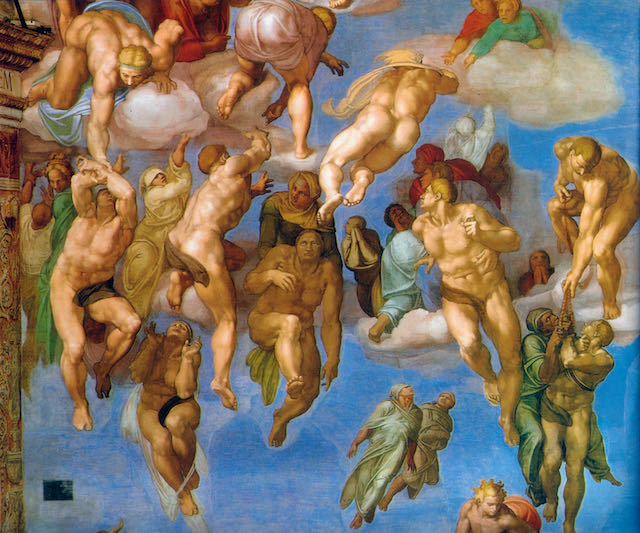 Michelangelo and the Sistine Chapel - he painted everyone nude because that is how he imagined they would meet the end of days. Humans are born naked and in the end they die naked.
Another critic was Fundamental Carafa who said that the painting was obscene and insisted that the genitals be covered.
Michelangelo refused, but i due north 1562 the Council of Trent issued a decree regulating the use of images in churches. Now the nudity had to exist covered.
Michelangelo'south pupil and friend Daniel da Volterra did it on his behalf, promising his friend he would disturb his original painting every bit little equally possible. This did little to placate Michelangelo.
Over time, more and more of the nudity was covered.
During the most recent restoration many of these blackness cloths were removed, but non the ones originally painted by da Volterra. The cloths left in place remind united states of america that without them, the painting might take been destroyed entirely.
Michelangelo died on February 18, 1564, days shy of his 89th altogether. How lucky are we that he lived so long and was able to give the globe and so much?
Michelangelo and the Sistine Chapel - a virtual tour
Click hither to visit the Vatican museums official website and accept a virtual tour of Michelangelo's masterpiece.
Michelangelo and the Sistine Chapel - bibliography
I hope you take enjoyed this page about Michelangelo and the Sistine Chapel! These are the resources I used most:
- Ross King, Michelangelo and the Pope's Ceiling
- Irving Stone, The Agony and the Ecstasy
- Giorgio Vasari, The Lives of the Artists
- Claudia Viggiani, Rome through My Optics
- Antonio Forcellino, Michelangelo - A Tormented Life
- Reliable online resources including Wikipedia, National Geographic, The Khan University, Vatican Museums
Want to save this folio near Michelangelo and the Sistine Chapel to Pinterest? Pivot it hither!
owenswhissilther68.blogspot.com
Source: https://www.romewise.com/michelangelo-and-the-sistine-chapel.html
0 Response to "According to Michelangelo the Highest Object of Art for Thinking Men Was"
Post a Comment